Introducing Darwin Ads & Darwin Studio
Darwin has fundamentally reimagined how brands advertise with creators and how creators monetize their content. This update breaks down the six-step process that powers both Darwin Ads (for brands and agencies) and Darwin Studio (for creators), showing how AI orchestrates thousands of product placements across the creator economy with zero manual work.
1. Creator Account Syncing
Creators connecting their YouTube, Instagram, and TikTok profiles to Darwin Studio
The process begins when creators connect their social profiles to Darwin Studio. We sync with YouTube, Instagram, TikTok, and other platforms to gain read access to their content catalog. This connection is instant and secure—creators authenticate via OAuth, granting Darwin permission to analyze their videos but never to post or modify content.
What makes this powerful is that Darwin immediately indexes the entire back catalog. A creator with 500 videos doesn't need to manually list each one for monetization. Our system automatically catalogs every video, noting metadata like view counts, engagement rates, audience demographics, and content format. This means even old evergreen content that still drives 10K+ monthly views becomes instantly monetizable.
2. Content Analysis
Darwin AI analyzing video catalog to identify optimal content formats
Once synced, Darwin's content analysis engine goes to work. This is where AI determines which videos are best suited for different types of product placements. The system analyzes video format (vlogs, tutorials, reviews), setting (indoor, outdoor, studio), visual composition (wide shots, close-ups), and audience retention patterns.
For example, a tech reviewer's desk setup videos might be flagged as premium opportunities for passive background placements—their audience actively studies the background looking for gear recommendations. A lifestyle vlogger's morning routine videos are perfect for integrated placements where products can be naturally incorporated. This analysis happens in seconds and categorizes thousands of videos automatically.
The analysis also identifies content velocity. Videos that consistently drive views months after publishing (evergreen) are valued higher because they deliver ongoing impressions. A tutorial with 50K monthly views for 18 months is more valuable than a viral video that spiked to 500K but now gets 1K/month.
3. Ad Slot Identification
AI identifying specific ad slots within creator videos
After analyzing content formats, Darwin identifies specific ad slots within each video. This is the breakthrough that makes programmatic creator advertising possible. Instead of brands negotiating vague "product placement" deals, they bid on precise, timestamped slots.
The AI scans each video frame-by-frame, identifying three types of opportunities: passive slots (visible background areas where products can appear), integrated slots (moments where the creator interacts with objects that could be branded), and active slots (segments where the creator speaks directly to camera and could mention a product).
Each slot is tagged with metadata: timestamp, duration, estimated impressions, audience demographics for that specific video, and suggested CPM range. A 10-second background placement at 2:35 in a tech review with 100K views might be listed as a passive slot at $8-12 CPM. This granular identification transforms content into programmatic inventory.
4. Brand Approval & Product Upload
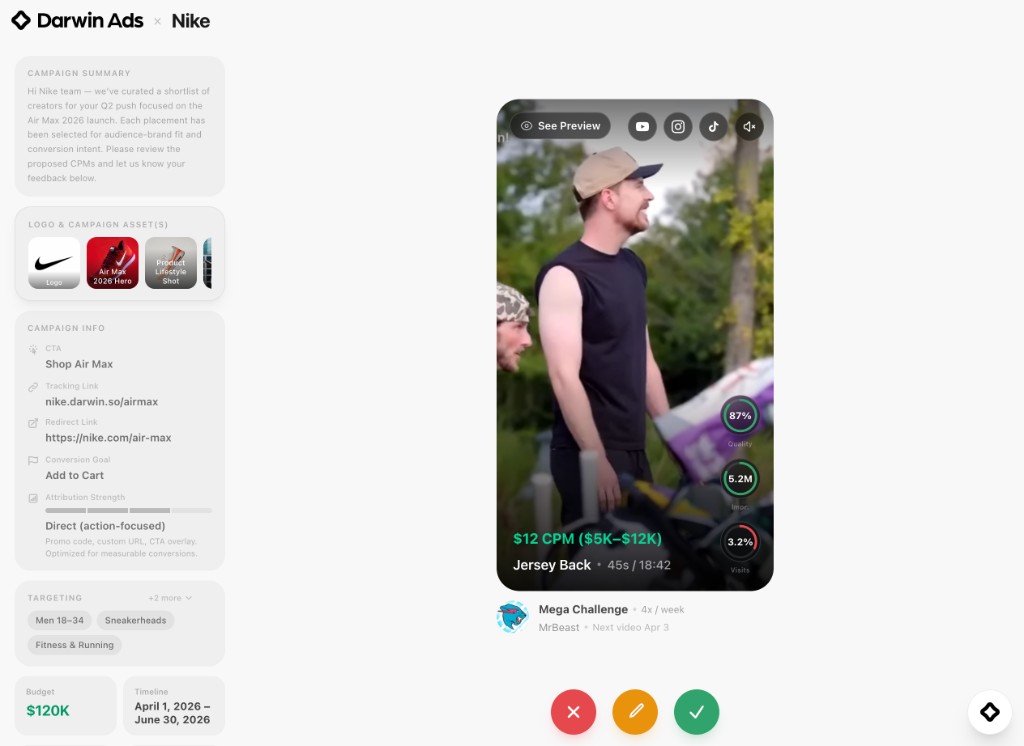
Brands uploading products and approving ad slots on Darwin Ads
On the Darwin Ads side, brands upload their products with 3D assets, images, and brand guidelines. They define targeting parameters—creator niche, audience demographics, content type—and set their CPM bid ranges. Then they review available ad slots that match their criteria.
The approval process is where Darwin's marketplace dynamics shine. Brands see previews of exactly where their product would appear, estimated view counts, audience demographics, and the creator's historical engagement rates. They can approve slots individually or set up automated bidding rules where Darwin's AI automatically bids on slots that meet specific criteria.
For creators, this means competitive bidding drives up their CPM rates. Instead of accepting whatever a brand offers in a traditional sponsorship, multiple brands compete for the same slot. A creator might list a passive slot at $10 CPM minimum, but if three brands want it, the final bid could reach $15-20 CPM.
5. Automated Product Placement
Darwin automatically placing products into videos with AI
This is where Darwin's technology becomes truly transformative. Once a brand approves a slot and the creator accepts the bid, Darwin automatically places the product into the video using AI. For passive placements, this means digitally inserting a product onto a shelf, desk, or background surface. For integrated placements, it could mean swapping a generic water bottle for a branded one throughout the video.
The AI handles lighting, perspective, occlusion, and motion tracking to make placements look native. A product placed on a desk will cast realistic shadows, reflect ambient light from the scene, and stay perfectly tracked as the camera moves. This level of quality is what makes programmatic placement viable—viewers can't distinguish AI-placed products from ones that were physically present during filming.
Creators maintain complete control. They approve every placement before it goes live and can reject any that don't meet their standards. But because Darwin's quality is consistently high, rejection rates are under 5%. The system learns from each approval or rejection, getting better at predicting what each creator will accept.
6. Programmatic Scale
Darwin repeating the placement process thousands of times per campaign
The final piece is scale. Darwin repeats this entire process—slot identification, brand bidding, creator approval, automated placement—thousands of times per campaign. A brand running a $100K campaign might secure 100-250 placements across 100s of different creators, all managed programmatically.
This is where the economics shift dramatically. Traditional creator campaigns require manual outreach to each creator, weeks of negotiation, custom content creation, and months of timeline management. That overhead caps most brands at 5-10 creator partnerships max. With Darwin, brands run campaigns with hundreds of creators simultaneously because the entire process is automated.
For creators, this means consistent monetization. Instead of hoping to land one $5K sponsorship per month, they earn from every video through micro-transactions. A creator with 20 videos per month might earn $500-2,000 per video through layered placements (passive + integrated + active), generating $10-40K/month—all automated, all performance-based.
Why This Matters
Darwin Ads and Studio together solve the fundamental inefficiency in creator advertising: matching supply and demand at scale. Brands want access to thousands of creators but can't manage that manually. Creators want consistent monetization but can't spend 40% of their time on brand deals. Darwin's infrastructure makes both possible.
The result is a creator economy that actually scales. Brands shift budget from traditional media into creator content because it's finally measurable and manageable. Creators earn sustainable income from their content without becoming full-time salespeople. And viewers get authentic product placements instead of disruptive pre-roll ads they skip anyway.
This January 2026 update represents where we are today: 1,000+ creators monetizing, 50,000+ active ad slots, 250M+ in creator audience reach. The infrastructure is working. The marketplace dynamics are healthy. And both sides—brands and creators—are seeing results that weren't possible before programmatic placement existed.
We'll be back in a few weeks with the next update. Stay tuned.
Authors & Contributors
Sanjit Juneja, Founder & CEO
Soham Parekh, Member of Technical Staff
Jason Festa, Creative Director